Saturday, April 26, 2014

Pollution as a Disaster, for more reasons than you'd think! (old post, 10 Apr. 2014)

We all know that pollution is and has been a serious issue for as long as every human on this planet has lived. It's been drilled into our heads since elementary school, and probably before that as well. But for whatever reason, nothing drastic is being done, and I assure you that drastic measures are needed. It may be our inability to relate with other life that is being noticeably affected by our pollution, our greed and laziness not wanting to change policy and technology to lessen emissions, but something that we can all rally around and understand, even the most ignorant among us are the human lives and our overall health that are being affected by this blatant negligence.


According to BBC news, it has been found recently that "Long-term exposure to air pollution contributed to more than 28,000 deaths across the UK in 2010, government figures show." And not only is this in total, but this is every year in the UK, particularly in the wealthier districts of London, and the southeast of the country. The government figures were produced by a study conducted by Public Health England, revealing that "5.3 per cent of all deaths in over-25s were linked to air pollution, although the figures varied considerably by region. Authors of the study said people whose death was hastened by pollution lost an average of 10.6 years of their lives." Imagine that, on average this pollution causes a loss of 11 years on an effected person's life. The amount of accomplishments and good that can be done in 11 years is immeasurable. This is definitely a man made disaster that can not go shrugged off as a "necessary evil" to turn a profit any longer. There are plenty of ways to combat pollution and utilize new green technologies, and while it may take a lot more time and money than we're putting in, it is completely worthwhile to the entire world, and coming together on this issue for once and actually make something happen is long overdue.


Something incredibly scary I heard about the other day then did some further research on was the fact that the US Navy has come up with a way to utilize sea-water (one of the Earth's most abundant resources if not the most) abundant as fuel, and it could be made into jet fuel for $3-$6 in the next decade, and its proven to work. CNN calls this a "game changer" and I completely agree with that statement. How is it that this technology that is completely clean burning, incredibly abundant, and more effective than current propulsion catalyst that we're not investing in it and working on it right away? Simply put, it's the power of large oil industries in the economies of nearly every western developed nation and our economic reluctance to let go of what we know. It could save tens of thousands of lives in the long run, and put an end to the smog that covers an unacceptably large portion of Asia. That number mentioned prior, 28,000 is nothing to ignore. It's about 10,000 more than the total wounded in Afghanistan yearly,  and significantly more than the yearly death toll of around 7,000. This isn't just a crisis, it is a disaster that human negligence will not let us push past.

 One final addition that I thought to be relevant in regards to pollution. There has been sensational coverage in the search for flight 370 lately, all over Asia. And according to the Washington Post "Five weeks into the search for missing Malaysia Airlines Flight 370, crews have not been able to locate the plane’s wreckage. What has become clear as the massive search continues is the staggering amount of trash in the Indian Ocean." There is so much trash in the Indian Ocean currently that it is actually difficult to find remains of an aircraft. It has been recorded that there are detached buoys the size of RV's that are just floating around, and countless numbers of plastic bottles. The Washington Post also writes that "The majority of the pollution, however, is smaller than a grain of rice. Over a long period of time, plastics are eventually broken down by sunlight and waves until they become particles that are invisible to the naked eye. These small particles still pose a problem for wildlife and potentially humans. Environmental groups are concerned that pesticides and chemicals latch onto them. Marine animals then ingest the particles, which either kills them or enters our food supply." Is it acceptable to eat entire bottles of plastic when consuming fish? The health risks associated with doing that are unimaginable. 

We are single handedly as a race destroying the Earth slowly but surely. The main cause of extinction of species is habitat destruction, and that is exactly what we are doing to ourselves, and it is resulting in the deaths of thousands, as well as many more to come. Coming together as a race and destroying borders is the only way we will rectify this issue, and without cooperation, this disaster could be what finally ends our long prosperous time on this planet, and possibly even end the planet itself.

Articles Used:

http://www.cnn.com/2014/04/10/tech/innovation/navy-new-technology/

http://www.bbc.com/news/uk-26973783

http://www.ecorazzi.com/2014/04/10/search-for-flight-370-reveals-terrible-pollution-problem/

Friday, April 25, 2014


Justice has been served (sort of)…a tad late, but the Marshall Islands have put in motion some interesting legal proceedings. The islands have officially filed a lawsuit in the International Court of Justice against the United States and the eight other nuclear counties in the world.

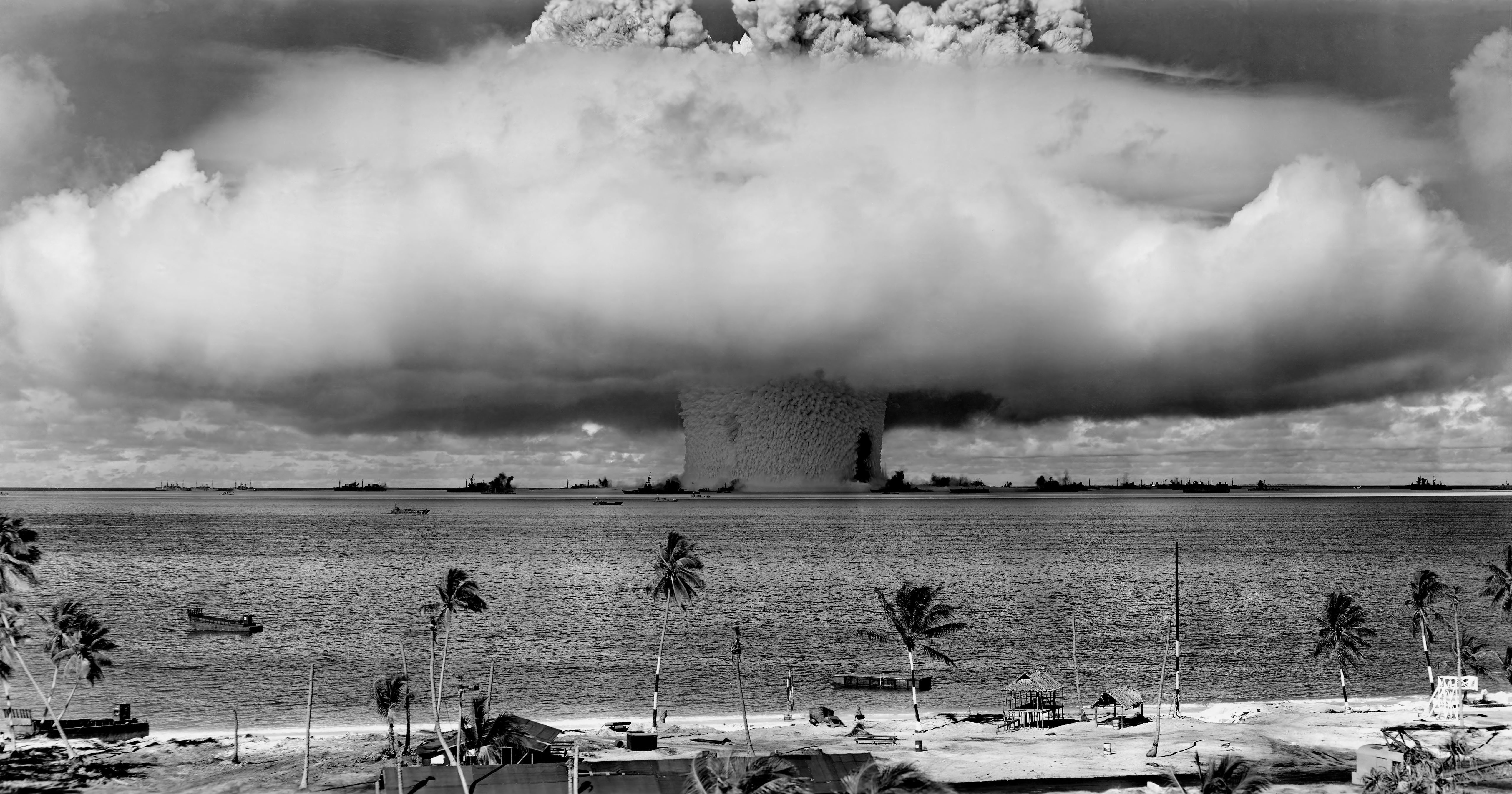
Even though the Marshall Islands is not a country that comes to mind when thinking of an international law enforcer, when it comes to nuclear laws and regulation they have a special claim. Experiencing 67 nuclear tests over 12 years, the Marshall Islands have experienced the disasters of nuclear testing, which has directly affected the lives of their citizens and environment. Their attempt at wrangling world superpowers into the international law is admirable but ultimately futile. By grouping nine countries together the likelihood of getting all the countries to scale down their nuclear programs is next to impossible. Attempting to reinforce a non-nuclear norm will ultimately fail because the self-interest of individual nations trumps one small nations, rather legitimate, claim that expanding nuclear disasters is just inviting disaster. The only true possibility of denuclearization ultimately lies in the powerful countries not a comparatively insignificant nation like the Marshall Islands. Possibly, strong nations leading by example will send a message to others that denuclearization is a serious commitment that world leaders are willing to take.


The power dynamics involved in this situation parallel, to me, the burgeoning crisis in Ukraine. The situation there is a political disaster that is threatening the peace in the region. Much like the Marshall Islands, Ukraine has attempted to influence a world power, Russia, through international discourse, to little effect. Unfortunately in both of these situations I feel that the upper hand clearly lies with the world powers. Regardless of whether or not results are attempted via international courts and norms like the Marshall Islands, the best bet in situations like the lawsuit and in Ukraine is for these weaker states to court a truly influential state for support. Frankly, it is too soon to tell for both the nuclear litigation and the Ukrainian Crisis. Hopefully, one day the international institutions will be strong enough to allow for actual equality for weaker states struggling to influence the world. Whether it is the potential for nuclear disaster that the Marshall Islands fear or the expansion of a political disaster into open war that Ukraine fears, for now it seems as though the answers to those uncertainties lie in the hands of the powerful.

Thursday, April 24, 2014

Is natural adverse weather a disaster? A look at USDA "disaster assistance"


The USDA has recently announced that it will begin providing payments to eligible farmers who have experienced losses since the livestock disaster assistance programs expired in 2011 as a part of the 2014 Farm Bill. This policy will cover farmers who have experienced "excess of normal mortality [of livestock] due to adverse weather". This covers death losses as well as grazing losses due to weather events such as droughts, wildfires, even blizzards. Disease is also considered as a claim for "disaster assistance". The assistance is provided through three main agencies: the Livestock Indemnity Program, the Livestock Forage Disaster Program, and finally the Emergency Assistance for Livestock, Honeybees and Farm-Raised Fish Program. There different requirements producers must meet to qualify for aid from the different agencies such as certain time constraints, being on publicly managed land, being hit by a drought above a specified severity(D2, D3, D4), or owning/leasing the affected livestock.


Is adverse weather a problem for farmers? Yes. Is it a disaster? I'm not sure, but does it matter?

This post ties back into our first discussions on defining "disaster" and more recently our discussion on discourse. It is extremely hard to determine what is or isn't a disaster, it is a definite gray area. For the sake of argument, this post will continue under the assumption that this policy making is in fact in response to a disaster not just using "disaster" to draw a reaction (another possibility).

The grounds for the disaster assistance policy are the basics of the problem so to speak. Adverse weather is causing a loss in grazing lands as well death losses of livestock, honeybees, and fish. Droughts and wildfires are destroying grazing land. Droughts, fires, disease, blizzards and other events are increasing the normal mortality rate these producers experience.


The warrants are the justifications for the policy. On a macro level, when producers experience losses it impacts food prices and as a result could negatively impact the economy. On a micro level, this impacts the livelihoods of the producers thus impacting their individual spending habits as well as impacting the disposable income of the consumer again having an effect on the economy.


The conclusion is the specific outline for action. This is the requirements of each agency for a producer to receive aid as mentioned above. The USDA has already announced multiple states that will be receiving aid: Texas, Nevada, Arizona, Oklahoma, as well as Idaho among others. The policy provides payments for drought are "equal to 60 percent of the monthly feed cost for up to five months". The losses had to have occurred on or after Oct 1, 2011 and be documented thoroughly. The registration for disaster assistance began April 15, 2014. The hope is to mediate the economic impact of these adverse weather affects. Basics of the policy are outlined by the 2014 Farm Bill (see link below) but more specific details can be obtained from local offices.

While the debate could be had about whether these adverse weather affects are really substantial enough to be considered a disaster, the fact that the USDA is using disaster discourse is clear. The grounds, warrants, and conclusions are all present in their announcements, policy legislation as well as in the media.

2014 Farm Bill Fact Sheet http://www.fsa.usda.gov/Internet/FSA_File/lfp_2014_fbill.pdf
Other links:
http://www.fsa.usda.gov/FSA/webapp?area=home&subject=diap&topic=landing

Silence of the media in Syrian refugees


Following the topic for this week and last week simulation, I wanted to focus my blog post on media coverage of Syrian refugees. 
The Syrian refugee crisis, labeled by the UN as the greatest humanitarian crisis in modern history, has overpassed 2.4 million of people flowing out of the country. Despite the catastrophic evidence, mass media is being quite silent about this issue. One of the articles that I read compared the media coverage on the missing Malaysian airplane to the reports on Syrian refugees. In a week the news about the Malaysian Flight 370 were 1800 at LexisNexis, this article explains, whereas the stories about Syrian refugees were 241. 
There could be many reasons for this lack of media coverage, and as Jessi explained in her post, one of them could be the ‘glamourization’ of disasters. Reporting about a refugee crisis requires most of the time stories of families and how they are living outside their home country, stories that can seem repetitive and monotonous after months of same news. However, the Malaysian airplane news seem more attractive for the public because of the peculiarity of the situation. 
Another explanation is that a great deal of the problem of media coverage in the Syrian refugee crisis involves the lack of proper reportage. Finding the areas of interest, translation for the interviews or safe regions makes really difficult for reporters to find a good story to cover.  Due to this scarcity, many media outlets are forced to use the same fixers, and therefore have less to report, leading to sometimes empty news stories.

Lack of media coverage about Syrian refugees can lead to extreme consequences that aggravate the crisis. The first one is the international response. Media coverage is essential for public awareness, and consequently for public response to the disaster or crisis. CNN International, for instance, has facilitated public information of the refugee crisis in Syria, creating a specific section called ‘How you can help’. Not only CNN has tried to cover stories of this crisis but also cooperate for active humanitarian response. Other consequence of limited media reports on the Syrian refugees crisis is the view of this issue in the neighboring and host countries. For instance, lack of international media coverage forming an opinion to the crisis, has lead to Egyptian news to condemn Syrian presence. TV presenters have accused Syrians of undermining their country’s well-being and threatened violence upon the refugees. 


With all this evidence, we can see the importance of media coverage on disasters and the consequences when there is a lack of it. The Syrian refugee crisis, specifically, has been worsened by the limited media coverage. The solution to the biggest humanitarian crisis in modern history, could be in hands of the media. How much influence mass media can have on disasters response and disasters solving? Does the media increase our awareness and response to disasters? 

http://www.juancole.com/2014/03/reasons-refugees-malaysian.html
http://www.cnn.com/SPECIALS/middleeast/syrian-refugees
http://borgenproject.org/lack-media-coverage-syrian-refugees/

The Disaster of Disease


In our talks this semester, we have discussed man-made disasters, natural disasters, and technological disasters such as the heartbleed bug Pedro talked about in his blog last week. I was surprised though that we didn't talk one specific kind of disaster this semester- the disaster of disease.

I was watching CNN on Monday afternoon with my roommate when after a commercial break, the popular news station moved on to a segment from health correspondent Dr. Sanjay Gupta. He was reporting on Ebola, a dangerous virus that has been eradicated in most developed nations-was spreading rapidly throughout the African nations of Guinea and Liberia. I though to myself, "Ebola? Nobody gets that anymore, at least here in America anyways." The disease, attacks the immune system and brings fever, headache, muscle pain and bleeding and could kill if not treated immediately. 


Doctors Without Borders on the scene in Guinea treating individuals infected with the virus.

The report was such a shock to me, I had to jog my memory the last time I had heard about a disease outbreak. The only one I could think of was the cholera outbreak in Haiti last year, which was reported to have been the worst outbreak in history. The situation in Haiti is now under control, as in Africa the death toll keeps rising, but the number of people contracting the virus is slowing. According to the World Health Organization, Ebola is one of the world's deadliest viruses and kills about 90% of the people who end up contracting the virus. Currently, 142 people have died from the virus and there is now a race to keep the virus from spreading into other countries. Sierra Leone was believed to have 19 cases of individuals infected with the virus, but the results came back negative. Doctors in Guinea and Liberia have no experience dealing with the virus, as this is the first time it has emerged in Western Africa.

Map of the countries affected by the spread of the virus.

Because Guinea and Liberia are not large nations, its geography could pose the potential problem of an entire nation being wiped out from the spread of disease. You could also look at this from a disaster stand point as well. While globalization becomes ever present in many developing nations-such as those in Africa- not only is there the spread of ideas and communication, but the spread of disease as well. What surprises me is that we do not treat the spread of deadly disease as a disaster. Roughly 36 million people worldwide are living with HIV/AIDS, a deadly virus that has become a widespread pandemic globally. So many people around the world are dying from the virus, but we often regard such a thing just as "pandemic". I think it's so much more than that. When we talked about natural disasters, we argued how it was a government's job to prepare, for the international community to intervene if the necessity prevailed, etc. The same went for any other disasters we discussed in class. I think those same principles can be applied regarding the spread of disease as a disaster. The Ebola outbreak is the evidence of that.

South Korea: Accountability and the Role of Culture in Disasters

On Wednesday, April 16th off the coast of South Korea, a ferry containing 476 people sank due to undetermined causes, claiming 171 lives. Many of the dead and missing are high school students and faculty on a school trip. This disaster has shocked and horrified the Korean people, and called into question how something like this could have happened. It brings up interesting issues of accountability in disasters—at the end of the day, who is responsible when things go wrong on such a monumental level? It also brings up an interesting commentary on the role that culture plays in disaster response and management.
South Korea is a country that has pulled itself out of poverty to become the world’s 15th-largest economy, which makes it even more stinging that this is being labeled a “third-world disaster.” Choi Kang, vice president of the Ansan Institute for Policy Studies in Seoul, said “we are supposed to be a prosperous middle power, but the fundamentals are still weak.” Part of the reason why the death toll was so high was because the crew was inexperienced and did not follow emergency procedures. They failed to notify the coast guard until 53 minutes in, and the captain and crew left the ship before even notifying most of the passengers as to what was going on. South Korean President Park Geun-hye, lashes out at them on Monday, saying the "behavior of the captain and some crew members is beyond understanding and no better than homicide." However, Park also faces accusations that her newly restructured Ministry of Security and Public Administration failed at its first disaster response. Not only that, but the boat was said to have had technical problems before the incident even occurred. In this situation, a lot of people are pointing fingers, but it is difficult to say who is responsible for poor crisis management in the wake of a completely preventable disaster like this. It also brings up a point we talked about in class, which was disaster preparedness and the importance of existing infrastructure. Although this is a relatively wealthy country, it did not have the fundamentals in place for an efficient response, which ultimately lead to the deaths of many students.


This also brings up the cultural aspect of disaster management. Since Korean children are taught to respect their elders from a young age, the students on the boat obeyed orders to stay in their cabins, and died because of it while the crew escaped. This has caused a huge sense of collective guilt among Koreans. “Koreans are very nationalistic and they take pride in the rapid development of their country. When there’s some problem or anything that reflects poorly on the collective, on the nation or Koreans on the whole, people will get upset about it,” said Daniel Pinkson, head of International Crisis Group in Seoul. It would be interesting to discuss in class the effects of cultural values on how people respond to a disaster (i.e. how a more individualistic nation like the U.S. would respond as opposed to a more collectivist one like China).

Sources: http://abcnews.go.com/International/ferry-disaster-left-south-korea-traumatized-shamed/story?id=23437866&singlePage=true
http://www.latimes.com/world/asia/la-fg-south-korea-calamity-20140423,0,480756,full.story#axzz2zmZMFOlH

Media and Disasters
Hey all, since the reading this week from Hannigan’s Disasters Without Borders is about Media and its influence on the politics of disasters, I’ve decided to do my blog post comparing the media coverage of disasters and how they shape the discourse surrounding an event.
For my case study, I chose a disaster that has been frequently population the international headlines recently, the annexation of Crimea by Russia. For context, in the past weeks Russia has made several bold moves by stirring Russian nationalist sediment in Crimea, an area of Ukraine that strategically borders the Black Sea and has a majority cultural and linguistic Russian population. Recently, in response to resistance by the Ukrainian government and some Ukrainians living in and around Crimea, Russia inserted a military presence into the region and has slowly began the process of annexing the region from Ukraine, citing a “referendum” that the Crimean population took that reflected a majority of the population supporting leaving Ukraine and joining Russia.
The crisis has received lots of attention from the international community and numerous of nations have condemned what appears to be a clear example aggressive imperialism by Russia. On the flip side, Russian president Vladimir Putin dismisses allegations of Russian pugnacity and has referenced Ukraine’s referendum as a rationale for annexing the territory. Notable about the situation also is Russia’s military and economic vested interest in Crimea. One of the Russia’s only warm water naval bases is in Crimea and operates it within the purview of the Ukrainian government. With recent developments however, Russia is in danger of losing operation authority over the base.
The reason why the Crimea Crisis is such a fitting guinea pig, ripe for analysis of the media coverage surrounding it is because it almost perfectly exemplifies how media coverage, and the political affiliations of said media outlets, help shape discourse surrounding a crisis along with frame the perspective that subscribers view the crisis hold. There is no better exemplar of dissimilarities between media coverage of the same event than the perspectives posited by The Washington Post, an American outlet, and The Moscow News, the longest running English-translated newspaper which is owned by the Russian state media outlet RIA Novosti. 
The Washington Post has run numerous articles covering the Crimean crisis, including “Russia threatens retaliation as Kiev orders military moves in eastern Ukraine” on 4/23/14 in which the authors report on the bellicose rhetoric of Russian Foreign Minister Sergei Lavrov stating that Russia would defend its interests militarily if provoked and drew illusions to Russia’s skirmish with Georgia over the South Osseita area in 2008. The article continues by documenting Ukrainian citizens and officials’ unrest and discontent over the advancing Russian military and political influence in the Crimean area. The article makes a point to reference the increasing kidnapping, assault, and other heinous crimes that are coming to light under the growing Russian military strong arm that is enveloping Crimea and surrounding areas of Ukraine.  Overall, the tone and rhetoric present in the piece conveys a very pro-Ukraninan report and tries to highlight the hostility and villainous behavior of the militarily domineering Russian might. The piece clearly espouses the general Western position of disdain and contempt toward Russian zeal to overtake Crimea.
Concurrently, the writing from The Moscow News on March 13th titled “Crimea could join Russia weeks after referendum” provides a markedly different outlook on the crisis. The article’s use of language, such as Russia “absorbing” Crimea after the “referendum” that reflected the majority of the province wishing to be annexed by Russia, illustrates the article’s attempt to downplay and avoid Russian aggression and malevolent influence in the event and euphemize the situation by obscuring some unflattering details about Russia’s imperial escapades. Additionally, the article also made sure to mention that Crimea is a linguistically and culturally majority Russian area in an attempt to soften Russian advances into the area and provide more of a rationale for Crimea to leave Ukraine.  
Reading the article from The Moscow News, which was written only a month before The Washington Post article I couldn’t help noticing the almost diametrically opposed tones, rhetoric, and subversive propaganda that are present in both. This drastic difference harkens back to Cold War tensions present between the US and the USSR throughout the 20th century. These tensions often manifest in the propaganda and rhetoric present in nation’s media outlets.  What the media feeds it’s subscribes often shapes opinions and cognition surrounding the same event. This phenomenon highlights a principle touched upon in John Hannigan’s Disasters without Borders chapter about mass media: Media outlets frame foreign disasters within a narrow “them vs. us” dichotomy where the U.S. media outlets tries to portray Russia as a foreign “other” with malevolent intentions through its coverage of events such as the crisis of Crimea while the Russian media tries to rationalize and defend its nations action while often omitting key information for media reports to purposely keep subscribes not fully informed on events such as the Crimean crisis. It is interesting to note how where one lives, what sources one derives their news, and what political affiliations said news organizations espouse can significantly meld the prospective one has on an event such as the Crimean crisis.

Water, Present Crisis, Future Disaster

Water Crisis

People are always arguing how society needs to find new ways of producing energy. Always stating that the oil crisis is becoming each time more prominent. But what many people fail to see is that there is another resources crisis that is also growing and becoming a bigger threat each day that passes. The water crisis has been growing problem and its effects are starting to become each day clearer. This vital resource is becoming each day scarcer and eventually it can developed into a world scale disaster.

            It is possible to see the scale of the water crisis by analyzing the current drought present in California. One of the major issues that the State government is facing these days. The droughts present in the state of California are affecting the crops and other industries present in the area. But the damage is not present only on the state. Other areas not only from the United States but from the world are starting to feel the consequences of the water crisis. The damage on the production levels of California are reflected on the overall capacity of the country which then can affected affiliated countries.

            As it was discussed the consequences and impacts of the water crisis do not stop only in the region directly affected by it. Many of the individuals and communities associated with the industries present in the region affected also suffer from the consequences. If by having a single state being affected by the drought it is already possible to feel an impact on the international community. Then what would happen if the whole nation suffered from the same disaster? What would be the implication on the international community? And how could the international community act to prevent such a disaster?


            In conclusion it is possible to state that the water crisis can be far more devastating then what may people imagine. It is a clear crisis that requires the action of the international community in order to prevent it from becoming a full scale disaster. In which case could cause way more devastation then it is causing today.


By Pedro Vargas

Media: Helping or Hurting Global Action?

Why does the media choose to highlight certain natural disasters and not others? An interesting article from the Daily Texan titled, “Media’s focus on celebrity aid lessens probability of political action,” calls to question the power of media on making effective change. We’ve given the media, with its 24/7 constant reporting, a power greater than any authority- in the sense that the media has the power to control politics. The media is aware of its ability to manipulate its viewers, and also the institutions that can enact change. But what the media also has the ability to do is create great inaction, desensitization, and an inactive global community.
            The article talks about celebrity aid, and how the spotlight is being put on the donors instead of the victims. The “glamourization” of natural disasters highlights and epidemic in our technology based society. Instead of looking at the factors contributing to a disaster or what’s being done, we’ve removed a sense of government accountability and need for policy reforms. For example, its important to analyze a situation, like Ethiopian famine and it’s history of oppression, government corruption and the mishandlement of foreign aid. Knowing the political, geographical, and sociological contexts are crucial when looking at the crises, because underneath every disaster there is a deeper instability that needs to be addressed. For global citizens, combating the medias portrayal of disasters come in three steps. Firstly, gather as much knowledge as you can about the circumstances in a disaster. And when you think you’ve understood the situation and what’s happening, keep looking for more. Look at the culture, the government, hear stories from the victims, but use knowledge as tool. The knowledge you gather is a means of power that we can hold over the media and say, “This is the reality of what’s going on, we won’t be satisfied with bias, one-sided stories for sensational purposes.” Secondly, if we’re pursuing knowledge then we must look at more quality of our news being produced, showing a bigger picture of the situation. We shouldn’t subscribe to bias news stations, which can be challenging especially for Americans that let it’s two party politics reflect a two-party media outlet. And lastly, we need to give more focus to the victims, not as stories of personal tragedy but how we can end human suffering. This will only happen if we enact larger institutional reforms and create a stronger, lasting structure like upholding international norms.

            Hopefully, we will touch on a lot of these issues tomorrow when we discuss the media. I think this issue really calls to question, as evident in this article. Although some people are altruistic when giving aid, is the media doing more harm than good to enact long-term institutional changes?   

Here is the link: http://www.dailytexanonline.com/news/2014/03/04/media%E2%80%99s-focus-on-celebrity-aid-lessens-probability-of-political-action

BP Oil Spill

            Remember the BP oil spill in 2011? On April 20th, 2010 an oil-drilling rig called the Deepwater Horizon exploded in flames 41 miles off the coast of Louisiana. It’s estimated that a total of 4.9 million barrels of oil, or 205.8 gallons, leaked from the well.
The BP oil spill is a perfect example of a man-made disaster, which we discussed in the beginning of the semester. According to the New York Times, BP was running weeks behind schedule and millions of dollars over budget prior to the explosion. Federal investigators concluded that BP took tons of shortcuts that led to the oil spill.                  

               
   The Bureau of Ocean Energy Management, Regulation, and Enforcement report stated that the pollution in the Gulf of Mexico was a result of poor risk management, last-minute changes to plans, failure to observe and respond to critical indicators, inadequate well control response and insufficient emergency bridge response training for the operation of the Deepwater Horizon. The report concluded that BP, as the well’s owner, was ultimately responsible for the accident. But it also said that BP’s chief contractors, Transocean, which owned the mobile drilling rig, and Halliburton, which was responsible for the cementing operations, shared the blame for many of the fatal mistakes.
If BP acted, as it should have, the oil spill would not have occurred. Instead, BP used dodgy cement for monetary reasons, misinterpreted a pressure test, and did not spot a leak.            
BP acted in its own-self-interest as any state would. BP knew that they it was running weeks behind schedule and severely under budget so BP took shortcuts in order to ensure its own safety. BP spent less money on cement and didn’t follow the Federal Laws and did not train their staff correctly. The disaster was a direct result of BP, Halliburton, and Deepwater Horizons actions but it was also worsened by their actions as well. The situation was made worse because none of the companies listed above wanted to admit fault and realize the extent of the situation. The oil spill was initially worsened by the immediate action taken after the oil spill.            
The example of the BP oil spill just goes to show environmental disasters can be byproducts of human action. If BP hadn’t cut back on spending money, the oil spill may not have happened. Which is something we have been talking about in class for weeks. We discussed how human action could worsen a disaster but… can human action cause a natural disaster? The answer is obviously yes.
Oil Spill today:


The BP oil spill also ties into to our discussion for tomorrow’s class, media coverage of disasters. Initially, the media made it clear that the BP oil spill was the worst environmental disaster that America had ever faced and called for immediate action. The media stressed the impact the oil spill would have on our fisheries and our economy as a whole with a strong emphasis on the eleven individuals who died. The media spent months on the BP oil spill, making the disaster even bigger then it was. In fact, the action that the media called for made the extent of the situation even worse initially and the media predictions about the extent of the disaster were far off. It is interesting how the media can determine the attention a disaster will receive even if the information they publicize is incorrect.                                                                                                                            
         In this case, however, the media coverage was so widely publicized because the disaster directly affected the United States of America. If this oil spill were to occur much further away from our borders, it would be interesting to see if the oil spill would receive as much help and/or as much air time as the BP oil spill did. Location and US self-interest are a big factor in deciding how the media portrays disasters, which is why it makes sense that the BP oil spill was so highly publicized. So what do you think, if an oil spill were to occur (same extent) further away from the US… would there be as much media coverage or would the media dismiss the oil spill and talk about the missing plane instead?

http://www.nytimes.com/2011/09/15/science/earth/15spill.html
http://www.nals.org/?p=3503

Tuesday, April 22, 2014

Internet Security – Can it become a Disaster?

In view that it is a topic that we did not discussed largely in class I thought that we could better expand and discuss this topic of internet security and how it can become a disaster through the blog.

            When we talk about disasters the first thing that one think is the physical, usually, natural disaster that have clear and physical consequences on society as a whole. As we discussed in class there are various factors that can cause or aggravate a disaster. We also discussed that there are other types of disaster then the natural disaster such as the man-made disasters. But there is one thing that is very close to us and that indeed have the potential to damage society in such a scale that trespass the damage caused by various natural and man-made disasters.
            Bank accounts, huge amounts of money, company and governmental secrets and various others information's that could damage society are present on the internet and therefore automatically in risk of being used against their purpose. Although there are various security mechanisms protecting these information's there is also people able to break those systems and get these information's.
            In the past years hacking attacks have happened constantly and the targets varied from governments, to companies and individuals. Examples of theses hacking attempts can be seen everywhere, Sarah Palin got her personal account during the elections and many governments around the world have suffered hacker attacks to government websites. In Brazil for example there are various threatens of hacker attacks in relation to the World Cup of 2014. These threats are being done in protest against the large expenditures that the government has made for the World Cup. The internet disaster is something that can happen at any time and it is almost impossible to predict when, where and how it will happen.
            
So I present the following question to all of you. How secure is the internet, and how much of a threat can it pose to us? Is this threat measurable?  How does the internet disaster compare to the other types of disasters that we have discussed before?


Sources:
http://www.cybernewsalerts.com/2014/02/several-italian-government-websites-are.html
http://www.reuters.com/article/2014/02/26/us-worldcup-brazil-hackers-idUSBREA1P1DE20140226
http://www.bbc.com/news/technology-26969629

By Pedro Vargas